


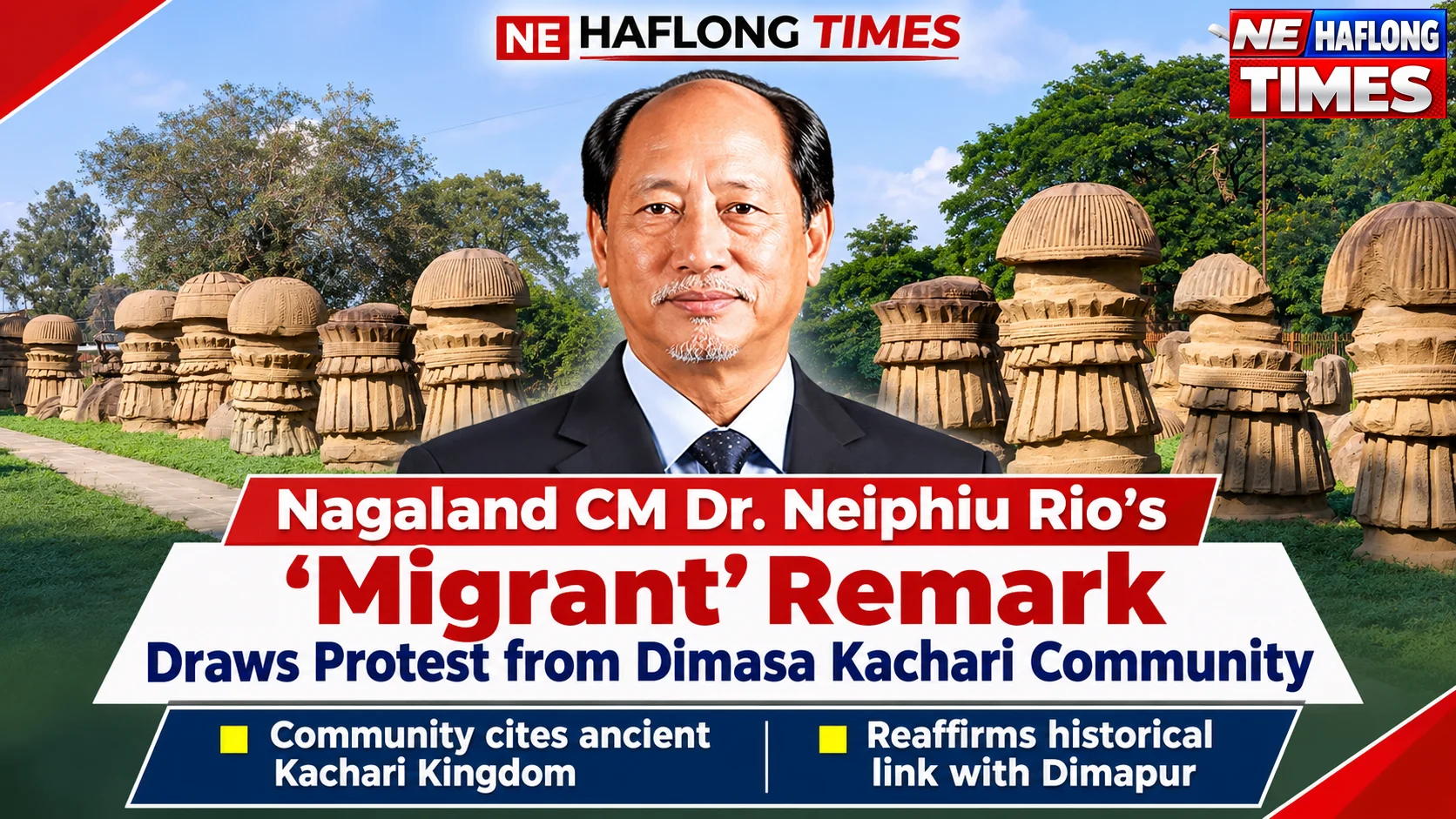
DIMAPUR, NAGALAND | NOVEMBER 3, 2026: Nagaland Chief Minister Dr. Neiphiu Rio’s recent remarks describing certain non-Naga communities, including Kacharis, as migrants have triggered strong objections from members of the Dimasa Kachari community, who have questioned the historical basis of such a classification.
The community maintains that its association with Dimapur dates back centuries and is deeply connected to the region’s historical, cultural and political heritage. Members have expressed concern that describing the Kachari community as migrants overlooks the existence of the ancient Kachari Kingdom, which once had its capital in present-day Dimapur.
DIMAPUR: THE HISTORICAL CAPITAL OF THE KACHARI KINGDOM
Historical records establish Dimapur as the ancient capital of the Kachari Kingdom, associated with the Dimasa people. According to the official historical account of the Dimapur District Administration, the Kachari rulers exercised authority in the region before the 13th century.
One of the strongest reminders of this historical legacy is the Kachari Rajbari Ruins, located in Dimapur. The site features ancient mushroom-shaped stone pillars, monoliths and archaeological remains associated with the Dimasa Kachari Kingdom. These monuments continue to stand as evidence of the region’s historical civilisation and royal heritage.
Historical accounts further record that following the decline of the Kachari capital at Dimapur, the royal seat shifted to Maibang in present-day Dima Hasao, Assam, before the kingdom later established its capital at Khaspur.
The name Dimapur itself also carries a connection to Kachari linguistic heritage. According to the Dimapur District Administration, the name originates from three Kachari words: ‘Di’, meaning river; ‘Ma’, meaning great or big; and ‘Pur’, meaning city. Together, they refer to a city near a great river.
These historical records and surviving monuments form an important part of the Dimasa Kachari community’s argument regarding its ancestral connection to Dimapur.
COMMUNITY QUESTIONS THE MIGRANT CLASSIFICATION
In this context, members of the Dimasa Kachari community have questioned how a community historically associated with the ancient kingdom that ruled from Dimapur can be broadly categorised as migrants.
Their concern follows remarks reported by Eastern Mirror on October 31, 2026, when Chief Minister Dr. Neiphiu Rio referred to four non-Naga tribes — Kuki, Kachari, Garo and Karbi — as migrants while discussing indigenous status, certificates and the protection of opportunities for indigenous Naga students.
According to the report, Rio also expressed concern over the issuance of indigenous certificates to certain communities and called for accurate surveys to distinguish indigenous inhabitants from migrants.
The remarks have brought renewed attention to the historical identity of the Dimasa Kachari community and its longstanding association with Dimapur.
CALL FOR HISTORICAL RECOGNITION AND EQUAL RESPECT
The Dimasa Kachari community has emphasised that Dimapur is today home to people belonging to different Naga tribes and several other communities who have settled in the region over generations.
Community members believe that historical identity, ancestral roots and cultural heritage deserve equal consideration. They have urged public representatives and concerned authorities to exercise sensitivity and responsibility when making statements concerning the identity and historical presence of different communities.
For the Dimasa Kachari community, the issue goes beyond a description or classification. It concerns the recognition of a historical legacy that remains visible through Dimapur’s ancient monuments, archaeological sites and the documented history of the Kachari Kingdom.
The community’s central concern is that the history of Dimapur and its connection with the Dimasa Kachari civilisation should be acknowledged while discussions on indigenous identity and migration continue.
 X (Twitter)

 Continue With Google